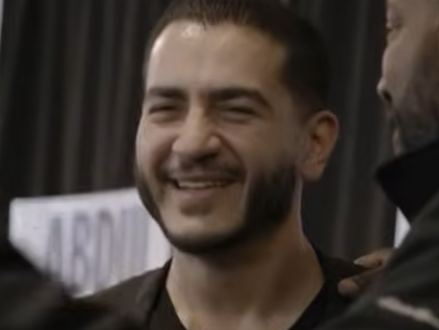
Michigan Democrats nominated Abdulrahman Mohamed El-Sayed (Now called Abdul El-Sayed) for U.S. Senate. Let’s look at what he actually said, what he actually is, and what he scrubbed from the internet before asking for their votes.
Michigan Democrats just nominated Abdul El-Sayed for Senate. He oversaw Detroit's animal shelter where the kill rate hit 74%, whistleblowers called it a slaughterhouse, and the city paid $63,000 to settle a lawsuit over the conditions. Feces backed up into kennels. Rats and… pic.twitter.com/MLpXmjHcgl
— Clown World ™ 🤡 (@ClownWorld) August 10, 2026
He calls himself a physician. He isn’t one.
El-Sayed has spent a decade introducing himself as a “physician and epidemiologist” — in op-eds, conference bios, campaign literature, and fundraising emails featuring him in a white coat. He has an MD from Columbia. That’s where it ends. Public licensing records in both Michigan and New York show he has never held a medical license in either state. He never completed a residency. He never sat for his boards. He never practiced medicine independently. By his own account, his clinical experience amounts to a four-week rotation at the end of medical school — a stint he himself once described as “cosplaying” a doctor and joked he was “the worst doctor on the team.”
New York law bars unlicensed individuals from calling themselves “physicians.” He did it there anyway, more than once. This isn’t a Republican talking point — his own primary rival’s campaign made the same accusation, arguing voters can’t trust him on policy if he isn’t straight about a credential central to his entire pitch.
His signature position
El-Sayed has made Medicare for All the centerpiece of his campaign, using his medical background to sell it as a doctor’s diagnosis of a broken system rather than just a policy position. He backs a single-payer system eliminating private insurance, funded through higher taxes on corporations and the wealthy. Critics note the price tag — estimates for national single-payer run into tens of trillions over a decade — and question the transition timeline he’s offered, which has shifted across interviews. Supporters counter that current premiums, deductibles, and denials already ration care, just privately. Whether Michigan swing voters buy the pitch may decide the race.
🚨 ALERT MICHIGAN – VOTE LIKE YOUR LIFE DEPENDS ON IT!
— Amy Mek (@AmyMek) July 29, 2026
DID YOU KNOW THAT ABDUL EL-SAYED’S WIFE REJECTS ALL INSURANCE (CASH ONLY) WHILE HE PUSHES MEDICARE FOR ALL – HER FATHER RAN CAIR & ISNA (MUSLIM BROTHERHOOD)
Abdul El-Sayed campaigns as the pure progressive warrior for… https://t.co/XZZiVrB5ei pic.twitter.com/KeEFYdts17
The internet he tried to erase
Ahead of launching his campaign, more than 100 of El-Sayed’s old YouTube videos were quietly set to private. CNN’s KFile dug them up anyway. Among the highlights:
- On guns: in a 2023 clip responding to a mass shooting, he floated scrapping the Second Amendment’s right to bear arms in favor of a constitutional right to health care.
- On the border: in a 2022 video, he waved off border security as an issue Republicans “love to flog,” saying it doesn’t crack the top five things Americans actually care about.
- On football: in an episode that’s still online, he questioned whether the sport could even be “ethical” or “safe,” and tied its culture to the same narratives historically used to justify slavery and westward expansion.
- On the Fourth of July: he posted that “fireworks suck” and asked followers to find another way to celebrate.
- On policing: older posts show him supporting the “defund the police” push — a position he now claims was taken out of context. In 2020, during the George Floyd protests, he explicitly backed the movement: “I believe we need to defund the police insofar as defunding the police is disinvesting in the means of incarcerating someone or killing them on the streets, and investing more in the means of educating and empowering, engaging communities…” At a University of Michigan seminar the same year, he went further, questioning whether officers need to carry guns at all: “Do police departments really need tanks and weapons of war… Do police really need to use guns? Do we need as much of a police force?” He also posted on social media that cities spend “WAY TOO MUCH” on policing. On the Senate trail, he’s flatly denied this — saying he “never, never called for defunding” — and deleted the old tweets, explaining he didn’t want them “taken out of context.” CNN’s KFile called that denial out directly, noting the 2020 record contradicts it. His campaign’s current line is that his position has “evolved,” and that he now supports better police recruitment/retention funding, restricting militarized policing, and passing the George Floyd Justice in Policing Act — reform-oriented, not defund/disarm.
His campaign’s response to all of it: old comments, cherry-picked, don’t reflect who he is today. That’s a really hard sell when the pattern is consistent and the deletions were timed to the campaign launch.
The rich landlord who rails against rich landlords
El-Sayed built his campaign on standing up to “greedy landlords” and corporate housing profiteers. Financial disclosures show he’s one himself — three times over. He and his wife, psychiatrist Sarah Jukaku, own rental properties in Ann Arbor, Bangalore, and a gated luxury development outside Dubai called Tilal Al Ghaf, complete with a man-made lagoon and “resort-style living,” carrying up to $100,000 in debt to the developer.
Combined, the properties are worth up to $1 million, and his 2025 household income hit $686,000 — nearly $450,000 more than during his 2018 run for governor, putting him in the top 1% of earners in the state he says he’s fighting for. The Dubai property disclosure landed just hours before his primary debate with Haley Stevens, after he’d already sought an extension to file it past the election. Asked about the foreign holdings, El-Sayed didn’t explain the timing — he waved off the scrutiny as bias, asking reporters, “I wonder why they’re so focused on foreign properties of somebody with a name like mine. Do you think it might fit within a well-worn trope?”
🚨 UPDATE: SPENCER PRATT just MIC DROPPED socialist Abdulrahman Mohamed El Sayed (D-MI)
— Eric Daugherty (@EricLDaugh) August 9, 2026
"This scammer owns 3 homes around the world."
"Literally all of these commies are scammers LARPing as victims of capitalism because they think you’re dumb!"
🫳🏻🎤
Nearly EVERY socialist is… pic.twitter.com/dsigsQ7GiO
It’s a convenient deflection for a self-styled populist who turns out to be a landlord collecting rent from three properties on two continents while running against people exactly like him.
Scum he stands alongside
El-Sayed campaigned repeatedly with Twitch streamer Hasan Piker, including at a rally after winning the nomination. Piker is the same commentator who said on a 2019 livestream, “America deserved 9/11, dude. F*ck it, I’m saying it” — a line he later walked back as “inappropriate” but never fully disavowed. Piker has also praised Mao Zedong as one of the “great leaders” of the world and said he’d back Hamas over Israel.
Every Black voter in America should know who Democrats are elevating as their new star. Hasan Piker, the streamer they keep putting on stage, said on camera, "I don't give a f*** what Black people care about", and "Let's go back to a better time, when lynchings were happening."…
— 🇺🇸 David J. Urban 🇺🇸 (@DavidJUrban) August 7, 2026
El-Sayed never said the 9/11 line himself, but he knew exactly who Piker was and campaigned with him anyway, brushing off the criticism as “cancel culture.” Hopefully voters will decide what it says about a Senate candidate’s judgment that this was the association he chose to maintain.
🚨 JUST IN: It's just been revealed that Michigan Senate candidate Abdulrahman Mohamed El Sayed advocated for ABOLISHING the 2nd Amendment and stopping the use of FIREWORKS on July 4th
— Eric Daugherty (@EricLDaugh) August 11, 2026
CNN: "He floated replacing the Second Amendment’s right to bear arms with a constitutional… pic.twitter.com/BLNRJiW27I
The pivot
Six years ago El-Sayed lost a Michigan governor’s race running well to the left. This cycle he ran the same primary playbook — Medicare for All, abolish ICE, break up corporate monopolies, get money out of politics — and won a bruising, expensive nomination fight. Now, days into the general election against Mike Rogers, the podcaster who called fireworks a public menace is photographed in a suit talking about “unity” and getting national Democratic heavyweights on the phone.
The question voters should ask isn’t whether he can talk like a moderate for three months — it’s which version was the act.
Abdul El-Sayed hot mic: "I hate Mackinac so much"
— End Wokeness (@EndWokeness) August 7, 2026
This is the most American place in MI pic.twitter.com/HDgoBNTHPV